
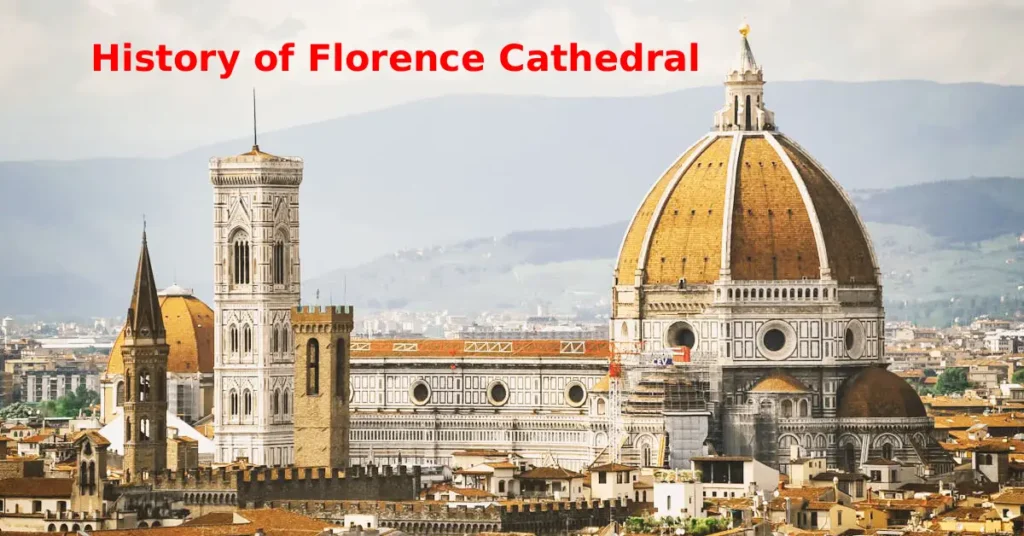
The history of the Florence Duomo spans over 1,600 years, from the 4th-century church of Santa Reparata to the completed Cathedral of Santa Maria del Fiore in 1436. The Duomo replaced an earlier basilica, took 140 years to build, and passed through four master architects: Arnolfo di Cambio, Giotto di Bondone, Francesco Talenti, and Filippo Brunelleschi. The cathedral served as the largest church in the world at its consecration. Pope Eugene IV consecrated the building on March 25, 1436. The Neo-Gothic façade was completed only in 1887 by Emilio De Fabris.
This guide traces the full history of Florence Duomo from its early Christian origins to its modern UNESCO status. Sections cover the Santa Reparata pre-history, the 1296 foundation, the four construction phases, the 1418 dome competition, Brunelleschi’s engineering breakthrough, the 1436 consecration, the Renaissance art commissions, the 19th-century façade, and the 1965-1974 archaeological excavations.
A Timeline of the Florence Duomo
The history of Florence Duomo follows clear date markers across 14 centuries. The table below maps every major event in chronological order.
| Year | Event |
|---|---|
| 4th-5th century | Original Santa Reparata church built on the site |
| 405 AD | Florentines name Saint Reparata as city patron after defeating Ostrogoths |
| 9th century | Santa Reparata becomes Florence’s main cathedral |
| 1296 (Sept 8) | Foundation stone laid by Arnolfo di Cambio |
| 1310 (c.) | Arnolfo di Cambio dies; construction slows |
| 1334 | Giotto di Bondone named master of works |
| 1337 | Giotto dies; Andrea Pisano continues |
| 1348 | Black Death halts construction |
| 1357 | Francesco Talenti expands the original plan |
| 1379 | Santa Reparata demolished |
| 1380 (c.) | Cathedral nave completed |
| 1418 | Dome design competition announced |
| 1420 | Brunelleschi starts dome construction |
| 1436 (March 25) | Pope Eugene IV consecrates the cathedral |
| 1446 | Brunelleschi dies; lantern construction begins |
| 1471 | Verrocchio’s gilded bronze ball placed atop the lantern |
| 1572-1579 | Vasari and Zuccari paint Dome’s “Last Judgment” frescoes |
| 1587 | Medieval façade demolished under Francesco I de’ Medici |
| 1601 | Bronze ball atop dome falls during a thunderstorm |
| 1876-1887 | Neo-Gothic façade completed by Emilio De Fabris |
| 1965-1974 | Archaeological excavations reveal Santa Reparata remains |
| 1972 | Brunelleschi’s tomb rediscovered |
| 1982 | UNESCO World Heritage Site designation |
Who Was Saint Reparata and Why Did Her Church Stand Here First?
Saint Reparata was a virgin martyr from 3rd-century Palestine. Florentines chose her as their patron after defeating the Ostrogoth king Radagaisus on her feast day in 405 AD. The victory triggered the foundation of the first cathedral, dedicated to her name. The Santa Reparata church stood on the same ground that the Duomo occupies today.
The Santa Reparata basilica dates back to the 4th or 5th century. The structure ranked among the largest early Christian complexes in Tuscany. The basilica held three naves separated by columns, with design elements borrowed from Ravenna’s Byzantine churches. The church served as Florence’s official cathedral from the 9th century until 1379. Santa Reparata also hosted the Parliament of the Florentine Republic before Palazzo Vecchio existed.
Who Laid the Foundation of Florence Cathedral?
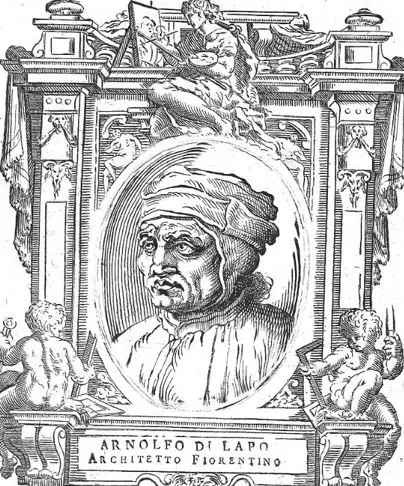
Arnolfo di Cambio laid the foundation of Florence Cathedral on September 8, 1296. Arnolfo was Florence’s leading Gothic architect at the time. The Arte della Lana (Wool Merchants’ Guild) commissioned the design and funded the project. Arnolfo’s plan called for a basilica with a Latin cross floor plan, three wide aisles, and capacity for 30,000 worshippers — a scale unmatched in Europe.
The Florentine Republic ordered the new cathedral to outshine the rival Tuscan cities of Pisa and Siena. The city wanted a structure worthy of its growing wealth from banking and the wool trade. The cathedral’s name, Santa Maria del Fiore (Saint Mary of the Flower), ties to Florence’s name as the “city of flowers.”
How Did Florence Cathedral’s Construction Progress Over Time?
Florence Cathedral construction unfolded across four phases between 1296 and 1436.
Phase 1: Arnolfo di Cambio (1296-1310)
Arnolfo di Cambio designed the original Gothic plan with the Latin cross layout. He completed sections of the apse and lower nave before his death around 1310. The site sat largely dormant for two decades after his death.
Phase 2: Giotto and Andrea Pisano (1334-1357)
Giotto di Bondone took over as master of works in 1334. Giotto focused his attention on the bell tower (Campanile) rather than the cathedral body. After Giotto’s death in 1337, Andrea Pisano continued the work. The Black Death of 1348 halted construction for nearly a decade.
Phase 3: Francesco Talenti (1357-1380)
Francesco Talenti expanded Arnolfo’s original design after the plague subsided. Talenti enlarged the nave, raised the planned dome dimensions, and completed the upper levels of Giotto’s Campanile. By 1380, the cathedral body was essentially finished — except for the missing dome.
Phase 4: Filippo Brunelleschi (1420-1436)
Filippo Brunelleschi won the 1418 dome competition and broke ground in 1420. Brunelleschi engineered the largest masonry dome ever built. The dome completed in 1436 and crowned the cathedral after 140 years of construction.
What Happened in the 1418 Dome Competition?
The 1418 dome competition was a public contest organized by the Opera del Duomo (cathedral works committee). The committee announced a 200-gold-florin prize for the design that could span the cathedral’s 45-meter-wide opening. Two main rivals entered: Filippo Brunelleschi and Lorenzo Ghiberti.
Brunelleschi and Ghiberti shared the project at first. Brunelleschi refused to share his engineering secrets and pretended to fall ill, forcing Ghiberti to admit ignorance of the construction method. The committee then handed Brunelleschi sole authority over the dome in 1423. The win established Brunelleschi as the leading architect of his era.
Why Is Brunelleschi’s Dome Considered a Technical Marvel?
Brunelleschi’s Dome is the largest masonry dome ever built. The dome weighs over 40,000 tons and spans 45 meters across. Brunelleschi solved four engineering problems that no architect had cracked before.
The four engineering innovations of Brunelleschi’s Dome:
- Double-shell structure — an inner and outer dome reduced overall weight
- Herringbone brick pattern — over 4 million bricks laid to redirect downward forces
- Tension rings — iron chains and oak rings embedded to counteract outward thrust
- Custom hoisting machinery — ox-powered cranes raised heavy materials to height
The dome rose without wooden centering, a method never attempted at this scale. Brunelleschi designed every tool used in the construction, including new types of cranes and lifting mechanisms. The dome remains the largest brick dome in the world today.
When Did Pope Eugene IV Consecrate the Florence Cathedral?
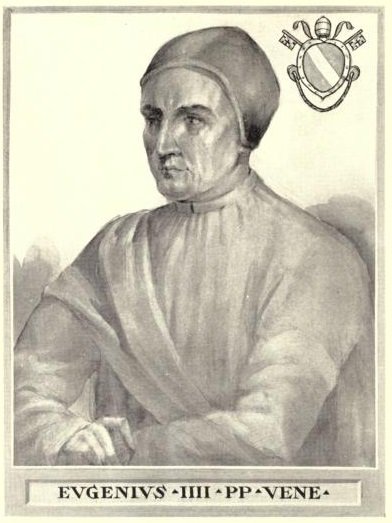
Pope Eugene IV consecrated the Florence Cathedral on March 25, 1436. The consecration date marked the Feast of the Annunciation and the start of the Florentine calendar year. The ceremony took place 140 years after Arnolfo laid the foundation stone. At consecration, the cathedral was the largest church in the world.
The composer Guillaume Dufay wrote the motet “Nuper rosarum flores” for the consecration ceremony. The Pope traveled to Florence specifically for the event during his exile from Rome. The cathedral kept its world-largest-church title until St. Peter’s Basilica in Rome was completed in the 17th century.
When Was the Florence Cathedral’s Façade Completed?
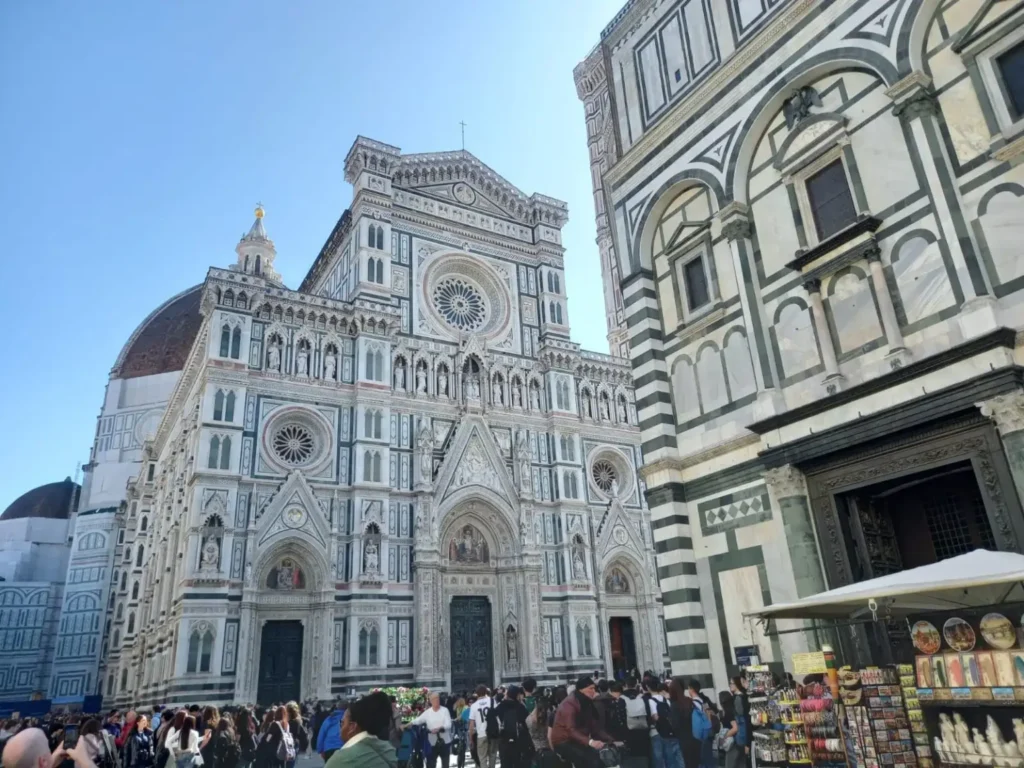
The Florence Cathedral’s façade was completed between 1876 and 1887 by Emilio De Fabris. The cathedral lacked a permanent façade for nearly 600 years after its foundation. The medieval façade started by Arnolfo di Cambio reached only the lower section before construction stopped.
In 1587, Grand Duke Francesco I de’ Medici ordered the partial medieval façade dismantled. The Medici planned a new design but never built one. The cathedral stood with a bare brick front for almost three centuries.
Emilio De Fabris won an 1864 competition for the current Neo-Gothic façade. Construction ran from 1876 to 1887. The façade uses green Prato marble, white Carrara marble, and red Maremma marble — the same palette as Giotto’s Bell Tower and the Baptistery. The three-portal design unifies Piazza del Duomo.
How Did the Cathedral Influence Renaissance Art?
The Florence Cathedral became a canvas for Renaissance masters across multiple generations. Donatello, Lorenzo Ghiberti, and Luca della Robbia produced sculptures, reliefs, and stained glass for the cathedral. Paolo Uccello painted the famous equestrian fresco of Sir John Hawkwood (1436) inside the nave.
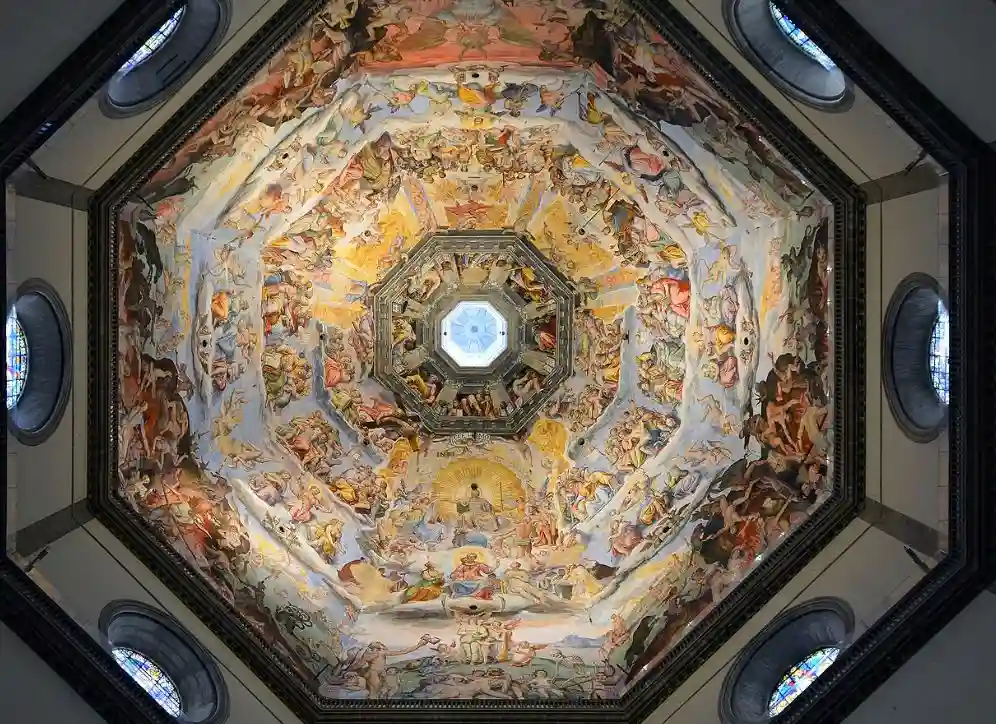
Inside the dome, Giorgio Vasari and Federico Zuccari painted “The Last Judgment” between 1572 and 1579. The fresco covers 3,600 square meters of the dome’s inner surface, making it one of the largest single fresco cycles in the world. The Last Judgment took the place of an unfinished mosaic that Brunelleschi had originally planned.
The stained glass windows include works by Donatello, Paolo Uccello, Lorenzo Ghiberti, and Andrea del Castagno. The 44 stained glass windows date from 1434 to 1455 and form one of the largest medieval glass programs in Italy.
Who Are the Historical Figures Buried Inside the Florence Duomo?
Yes, several historical figures rest inside the Florence Duomo. The most famous burial is Filippo Brunelleschi himself, whose tomb sits in the crypt of Santa Reparata beneath the cathedral floor.
Notable burials inside the Duomo complex:
- Filippo Brunelleschi — architect of the dome, tomb rediscovered in 1972
- Pope Stephen IX — 11th-century pope, buried in Santa Reparata
- Pope Nicholas II — 11th-century pope, buried in Santa Reparata
- Giovanni de’ Medici (the Gonfaloniere) — Medici family member
- Saint Zenobius — first bishop of Florence (relics in the cathedral)
Historical records suggest Giotto, Arnolfo di Cambio, and Andrea Pisano were also buried inside Santa Reparata, but their remains have never been found during excavations.
What role does the Cathedral play in modern Florence?
Today, Santa Maria del Fiore remains both a place of worship and a global landmark. Visitors climb Brunelleschi’s Dome for panoramic views, explore Santa Reparata’s crypt, and witness mass under the frescoed vaults. The cathedral continues to unify history, art, and living faith in one enduring monument.
When Did the Florence Duomo Receive UNESCO Status?
The Florence Duomo received UNESCO World Heritage status in 1982. The designation includes the cathedral, Giotto’s Bell Tower, and the Baptistery of San Giovanni as part of the Historic Centre of Florence. UNESCO recognized the cathedral’s role in launching the Renaissance and its preservation across 14 centuries.
The UNESCO listing covers the entire walled historic center of Florence. The Duomo complex anchors the protected zone alongside Palazzo Vecchio, the Uffizi Gallery, and the Ponte Vecchio. The status protects the buildings from major structural changes and supports ongoing restoration work.
Where Is the Florence Duomo Located Today?
The Florence Duomo sits in Piazza del Duomo at the center of Florence’s historic district. The piazza holds three connected monuments: the Cathedral of Santa Maria del Fiore, Giotto’s Campanile, and the Baptistery of San Giovanni. The Opera del Duomo Museum sits one block east on Via del Proconsolo.
The Duomo’s official address is Piazza del Duomo, 50122 Firenze, Italy. The cathedral remains a working parish church and the seat of the Archbishop of Florence. Daily Mass services run alongside the millions of annual tourists who visit the complex.
Do I Need to Book a Ticket to Visit the Florence Duomo?
The main cathedral interior is free to enter. Visitors pay nothing to see the nave, the high altar, and the floor view of Vasari’s Last Judgment fresco. The free entry queue forms outside Door 1 of the cathedral and moves quickly outside peak hours.
Paid passes cover the other monuments in the Duomo complex:
- Brunelleschi Pass — €30, includes dome climb, Baptistery, Bell Tower, Crypt, Museum
- Giotto Pass — €20, includes Bell Tower, Baptistery, Crypt, Museum (no dome climb)
- Ghiberti Pass — €15, includes Baptistery, Crypt, Museum only
The dome climb covers 463 steps with no elevator. Book the Brunelleschi Pass two months ahead in peak season at tickets.duomo.firenze.it. The Brunelleschi tomb sits inside the Santa Reparata crypt entry.
How old is the Florence Duomo?
The Florence Duomo is over 700 years old. Arnolfo di Cambio laid the foundation stone on September 8, 1296. The cathedral was consecrated by Pope Eugene IV on March 25, 1436. The construction took 140 years across four master architects. The Neo-Gothic façade was added later, between 1876 and 1887.
Who built the Florence Duomo?
Four master architects built the Florence Duomo across 140 years. Arnolfo di Cambio designed the original Gothic plan in 1296. Giotto di Bondone took over in 1334 and built the bell tower. Francesco Talenti expanded the design after the Black Death. Filippo Brunelleschi engineered the dome between 1420 and 1436.
Why Florence Duomi is called Santa Maria del Fiore?
The Florence Duomo is officially named Santa Maria del Fiore, meaning “Saint Mary of the Flower.” The name honors the Virgin Mary and links to Florence’s identity as the “city of flowers.” The official name dates to a 1412 decree by the Florentine Republic. Locals still call the cathedral “the Duomo” in daily speech.
What church stood before the Florence Duomo?
The church of Santa Reparata stood on the Duomo’s site before the Duomo. Santa Reparata dates to the 4th or 5th century and served as Florence’s cathedral from the 9th century until 1379. The basilica honored Saint Reparata, a 3rd-century Palestinian martyr. Florentines chose her as patron after defeating the Ostrogoths in 405 AD.
How long did Brunelleschi take to build the dome?
Brunelleschi took 16 years to build the Florence Duomo dome. Construction ran from 1420 to 1436. The lantern at the top of the dome was completed later, between 1446 and 1471 by Andrea del Verrocchio. The full dome with lantern took 51 years from the start of construction to the final gilded ball placement.
Where is Brunelleschi buried?
Brunelleschi is buried inside the Florence Duomo, in the crypt of Santa Reparata beneath the cathedral floor. Archaeologists rediscovered his tomb in 1972 during the 1965-1974 excavations. The tomb sits in the entrance area of the crypt bookshop. Visitors with a Duomo pass enter the crypt through a stairway in the right aisle of the cathedral nave.
When did the Florence Duomo become a UNESCO site?
The Florence Duomo became part of a UNESCO World Heritage Site in 1982. The designation covers the Historic Centre of Florence, including the cathedral, the Baptistery of San Giovanni, and Giotto’s Campanile. The listing recognizes the Duomo’s role as the launching point of Renaissance architecture and its preservation across 14 centuries.